AutomatiqData
Turn fragmented supplier catalogs into intelligent, compliant procurement decisions
A catalog intelligence platform that consolidates, normalizes, and enriches supplier product data into a single, trusted source for purchasing and analysis.
Mind the Gap: Why Typical ERP Isn’t Enough
The Difference Between "Data Flow" and "Data Intelligence" Enterprise systems—Oracle, SAP, Infor—are the heavy lifters for organizations. They are designed to manage the "What" and the "How Much": SKUs, pricing, inventory, and logistics.
Standard ERP pipelines are built for internal transactions, not for external context. Suppliers typically bridge this gap with manual labor or fragile, in-house "patchwork" code. This is the Context Gap—and it is where AutomatiqData captures value.
Why the Gap Matters
This Context Gap is where potential contracts are lost and where most generic data loses its competitive edge. Customers (Federal Agencies, Universities, Local Governments) aren't just buying a product; they are buying compliance, sustainability, and performance.
How We Fill the Gap
The Intelligence Layer for Existing Pipelines
AutomatiqData doesn't replace your ERP; it completes it. We provide the Intelligence Layer that hooks directly into your current data streams to inject the "Who" and the "How Well."
-
Enriched Matching We map your internal data to external certifications (ISO, ESG, B-Corp) and category criteria that don't exist in your master data.
-
Dynamic Performance Insights We layer in real-time performance metrics so your data tells a story of reliability, not just availability.
-
Audit-Ready Compliance We ensure every piece of data moving through your pipeline is aligned with the specific claims and reporting standards your public sector clients demand.
The Build vs. Buy Dilemma
It is tempting to think, "We have an IT team; we can build this matching engine ourselves." While technically possible, the "Build" route is fraught with hidden costs and systemic risks that often outweigh the perceived control. Don't turn your data team into a "plumbing" department.
The "Build It Yourself" Risk
- The Maintenance Trap
- APIs change, certification standards evolve, and schemas shift. Your team will spend 40% of their time just "keeping the lights on."
- The Expertise Gap
- Accurate matching requires deep domain knowledge of federal procurement and category logic. Generalist engineers often miss these nuances.
- Delayed Time-to-Value
- Building a custom enrichment engine typically takes 6–12 months. That’s a year of missed opportunities.
- Single Point of Failure
- In-house builds often rely on one or two key architects. If they leave, your data pipeline becomes a "black box" no one can fix.
The AutomatiqData Advantage
- Zero Maintenance
- We handle all the heavy lifting of API updates and certification tracking. Your data is always current, without lifting a finger.
- Expert-Led Logic
- Our algorithms are built specifically for public sector and enterprise procurement nuances, ensuring 99.9% matching accuracy.
- Rapid Deployment
- We hook into your Oracle, SAP, or Infor streams in weeks, not months. You see the value in the next quarter, not the next year.
- Scalable Infrastructure
- You get a platform supported by a dedicated team, 24/7 monitoring, and a roadmap that evolves with the industry.
AutomatiqData
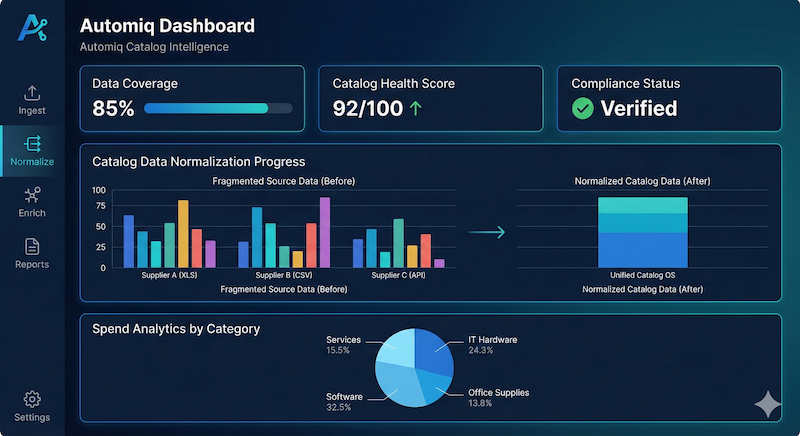
A catalog-first intelligence platform that automates ingestion, normalization, and enrichment—transforming raw catalogs into an analytics-ready foundation for procurement performance and AI-driven insights.
Ingest
Unified ingestion across formats and delivery methods—reliable, repeatable intake without manual rework.
Normalize
Attribute standardization, category alignment, and de-duplication for accurate comparison and reporting.
Product Intelligence
Product-supplier-category relationships and attribute reasoning for deeper analysis beyond catalog fields.
Compliance Intelligence
Certification tracking and audit-ready reporting to validate supplier performance with data.
Four Simple Steps
Ingest
Continuously ingest supplier catalogs, price files, and product data across formats—no vendor lock-in.
Normalize
Standardize products, categories, and attributes into a single, comparable catalog.
Enrich
Enhance with supplier claims, performance signals, and derived insights like pricing variance.
Decide
Power smarter purchasing with data-driven recommendations and human-in-the-loop controls.
Built for Data Providers and Enterprise Integrators
Enterprise Data Suppliers
For companies managing complex pipelines from manufacturers to vendors—enrich internal data with external criteria.
Public Sector Providers
Navigate rigorous procurement demands with data that's not just delivered, but audit-ready and fully aligned.
Institutional Networks
For providers servicing large, decentralized environments like university systems or government coalitions.
Turn fragmented catalogs into a strategic asset
Vendor-Neutral Intelligence
Unify catalogs across formats into a single, vendor-agnostic layer for true cross-supplier comparison.
Semantic Normalization
Align products based on meaning and equivalency—not just fields—so analytics reflect real buyer behavior.
Performance-Driven Enrichment
Transform static data into actionable intelligence with performance metrics and derived insights like supplier LTV.
Decision-Ready Outputs
Clean, trusted data that integrates into existing workflows—better decisions without replacing current systems.
Ready to unify your supplier data?
AutomatiqData improves data quality, transparency, and decision-making across procurement, sustainability, and compliance workflows.